The Adab Colloquium: Workshop with Mana Kia and Sunil Sharma

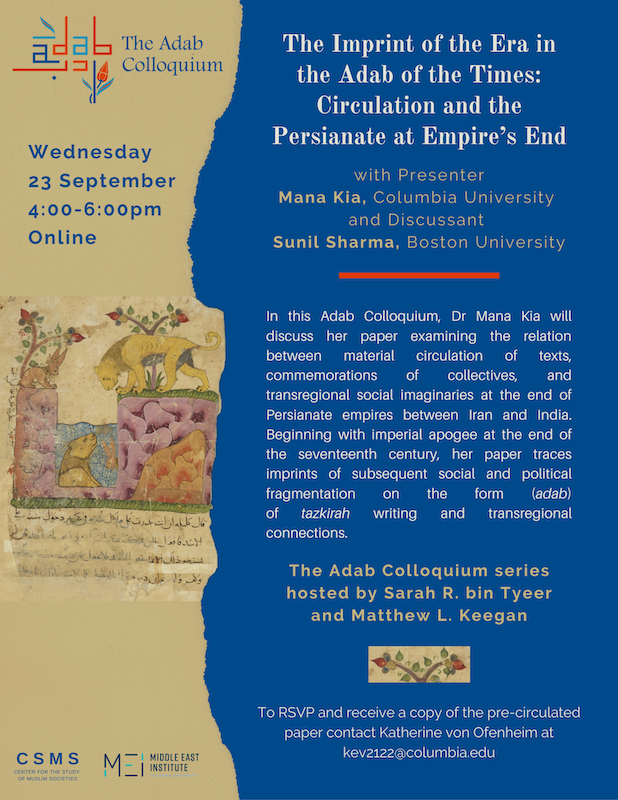
The Imprint of the Era in the Adab of the Times: Circulation and the Persianate at Empire’s End

Wednesday, September 23, 2020. 4:00-6:00 pm
AdabColloquiumSept23.png

In this Adab Colloquium, Dr. Mana Kia will discuss her paper examining the relation between material circulation of texts, commemorations of collectives, and transregional social imaginaries at the end of Persianate empires between Iran and India. Beginning with imperial apogee at the end of the seventeenth century, her paper traces imprints of subsequent social and political fragmentation on the form (adab) of tazkirah writing and transregional connections.

This event will take place online over Zoom. To RSVP and receive the link to join and a copy of the pre-circulated paper please contact Katherine von Ofenheim at kev2122@columbia.edu.

The Adab Colloquium in Columbia is a platform for scholars whose work engages with the range of adab practices of reading, writing, and performance from the 6th century down to the 19th century. The colloquium brings together faculty and graduate students from Columbia and other universities in the region for intensive discussions of new research by leading specialists invited from the US and abroad.
Matthew L. Keegan: The Stakes of Editing the Unruly Past

Faculty Profile

Matthew L. Keegan is the Moinian Assistant Professor in the Department of Asian and Middle Eastern Cultures at Barnard College. His research focuses on Islamic intellectual history and adab (usually translated as "literature" or "belles-lettres"). In particular, he writes about the commentaries on al-Hariri's Maqamat, a 12th-century collection of stories about an eloquent trickster.

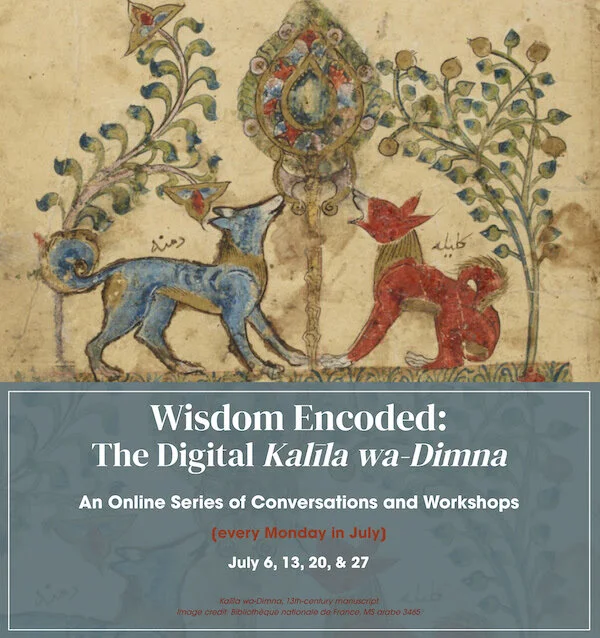
Over the course of July 2020, he is moderating a series of online workshops hosted by the Columbia Global Center in Amman about Kalila wa-Dimna, a collection of stories about fictive humans and talking animals. Kalila wa-Dimna is the subject of the AnonymClassic ERC-sponsored project where Professor Keegan completed a postdoctoral fellowship in 2019. The following post discusses the very different manuscript traditions of Kalila wa-Dimna and al-Hariri's Maqamat.

The Stakes of Editing the Unruly Past

Arabic manuscripts are documents of social and intellectual history. The scribes who copied them, the readers who perused them, and the scholars who scribbled notes in their margins were all involved in shaping the way that manuscripts came to be read by their later readers. When texts from before the dawn of Arabic print culture in the 19th century came to be edited and put in print, editors often erased these testaments to the social lives of manuscripts.

Consider, for example, the case of al-Hariri's Maqamat, which was first read aloud to an audience of scholars in Baghdad in the year 1111 AD. Most copies of the Maqamat do not contain the brilliant illustrations that have become popular on book covers and event posters. Most copies contain the scribbles of later readers who glossed and annotated the text in the course of their reading and study.

Read More

Video Recording: New Moon Rising Concert

We are very pleased to share with you a recording of the "New Moon Rising" live performance on May 30th, 2020 to celebrate Columbia University's 2020 graduating class, and to mark the launch of the Center for the Study of Muslim Societies (CSMS).

This extraordinary concert featured Salieu Suso, Amir Sulaiman, Maimouna Youssef, Zeshan B, Rachid Halihal, Alsarah of the Nubatones, Amir ElSaffar, Irfaan Bukhari, Mitra Sumara, Akram Ahmad Al-Mustafa, and Maalem Hassan Benjaafar whose biographies may be found here.

The CSMS faculty are very grateful to these diverse musicians for sharing their incredible talents in this concert. Their artistry broke through the confines of remote performance and touched people around the world. In solidarity with movements in protest of racial inequalities, racism and bigotry, their shared voices transcend boundaries and demonstrate how we can all unite.

00:00 Salieu Suso 10:43 Introduction 14:30 Amir Sulaiman 27:43 Maimouna Youssef 42:49 Zeshan B 58:52 Rachid Halihal 1:15:18 Alsarah 1:25:15 Amir Elsaffar 1:43:08 Irfaan Bukhari 1:53:30 Mitra Sumara 2:00:12 Akram Ahmad Al-Mustafa 2:18:28 Maalem Hassan Benjaafar