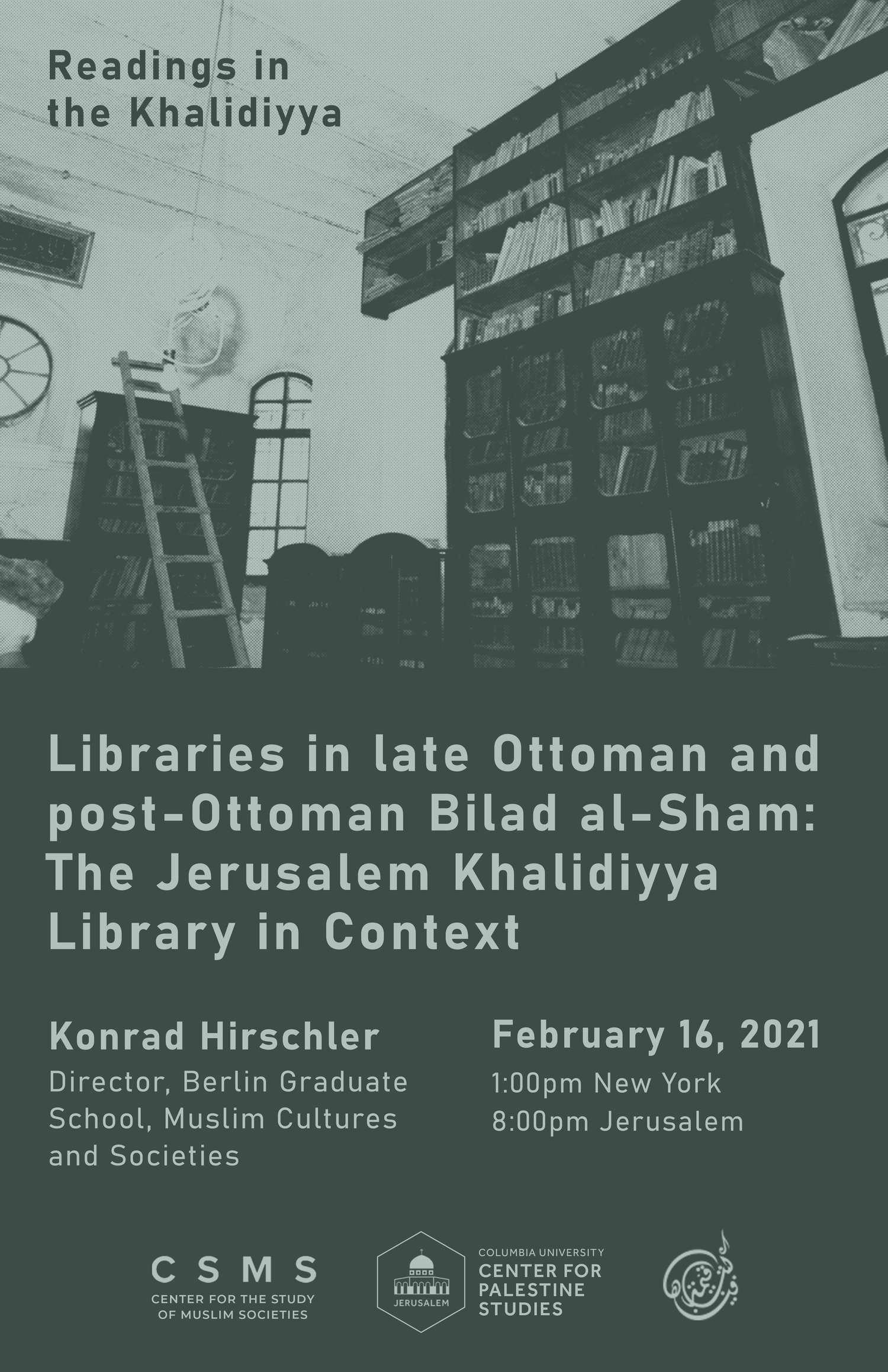
February 16: Readings in the Khalidiyya: Libraries in late Ottoman and post-Ottoman Bilad al-Sham

Tuesday, February 16, 2021, 1:00 PM - 3:00 PM EST

Register for the Zoom webinar here.

Join us for the next installment of Readings in the Khalidiyya, a series about The Khalidi Library’s manuscript collection, accessibility through digitization and new scholarly inquiries.

Konrad Hirschler, a leading scholar on regional libraries such as the Khalidiyya will give his talk, “Libraries in late Ottoman and post-Ottoman Bilad al-Sham: The Jerusalem Khalidiyya Library in Context" on 16 February 2021 at 1pm NY/ 8pm Jerusalem. He is Professor and Director, Berlin Graduate School of Muslim Cultures and Societies.

For information about The Khalidi Library, visit its website.

Did you miss the first event in our series last fall? Watch the recording here.
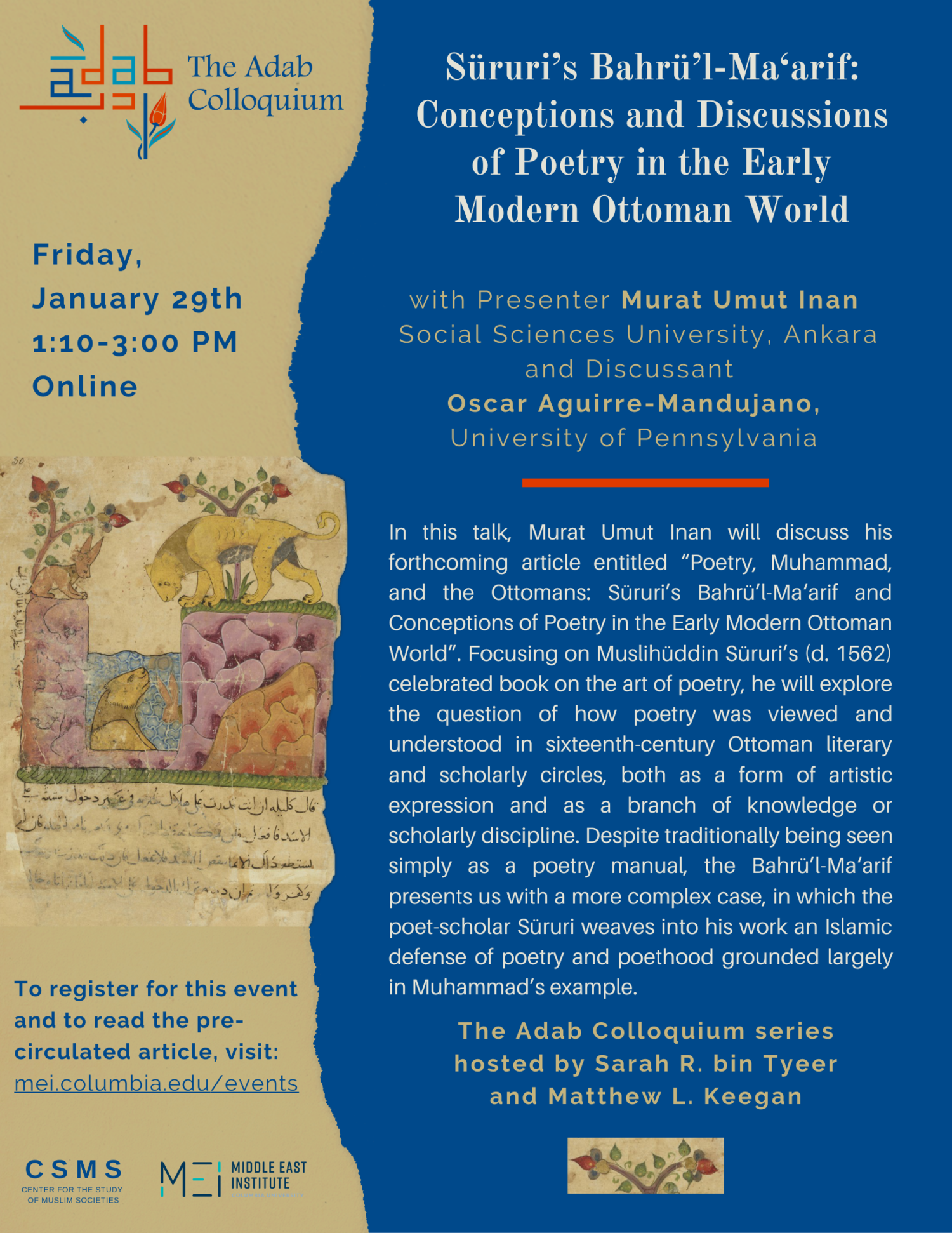
January 29: Adab Colloquium with Presenter Murat Umut Inan and Oscar Aguirre-Mandujano

Friday, January 29, 2021, 1:10 PM - 3:00 PM

Register for the Zoom webinar here.

In this talk, Murat Umut Inan will discuss his forthcoming article entitled “Poetry, Muhammad, and the Ottomans: Süruri’s Bahrü’l-Ma‘arif and Conceptions of Poetry in the Early Modern Ottoman World”. Focusing on Muslihüddin Süruri’s (d. 1562) celebrated book on the art of poetry, he will explore the question of how poetry was viewed and understood in sixteenth-century Ottoman literary and scholarly circles, both as a form of artistic expression and as a branch of knowledge or scholarly discipline. Despite traditionally being seen simply as a poetry manual, the Bahrü’l-Ma‘arif presents us with a more complex case, in which the poet-scholar Süruri weaves into his work an Islamic defense of poetry and poethood grounded largely in Muhammad’s example.

Learn more about the Adab Colloquium at MEI here.

If you are interested in attending this event please download the pre-circulated reading.

Adab+Colloquium+1-29.png

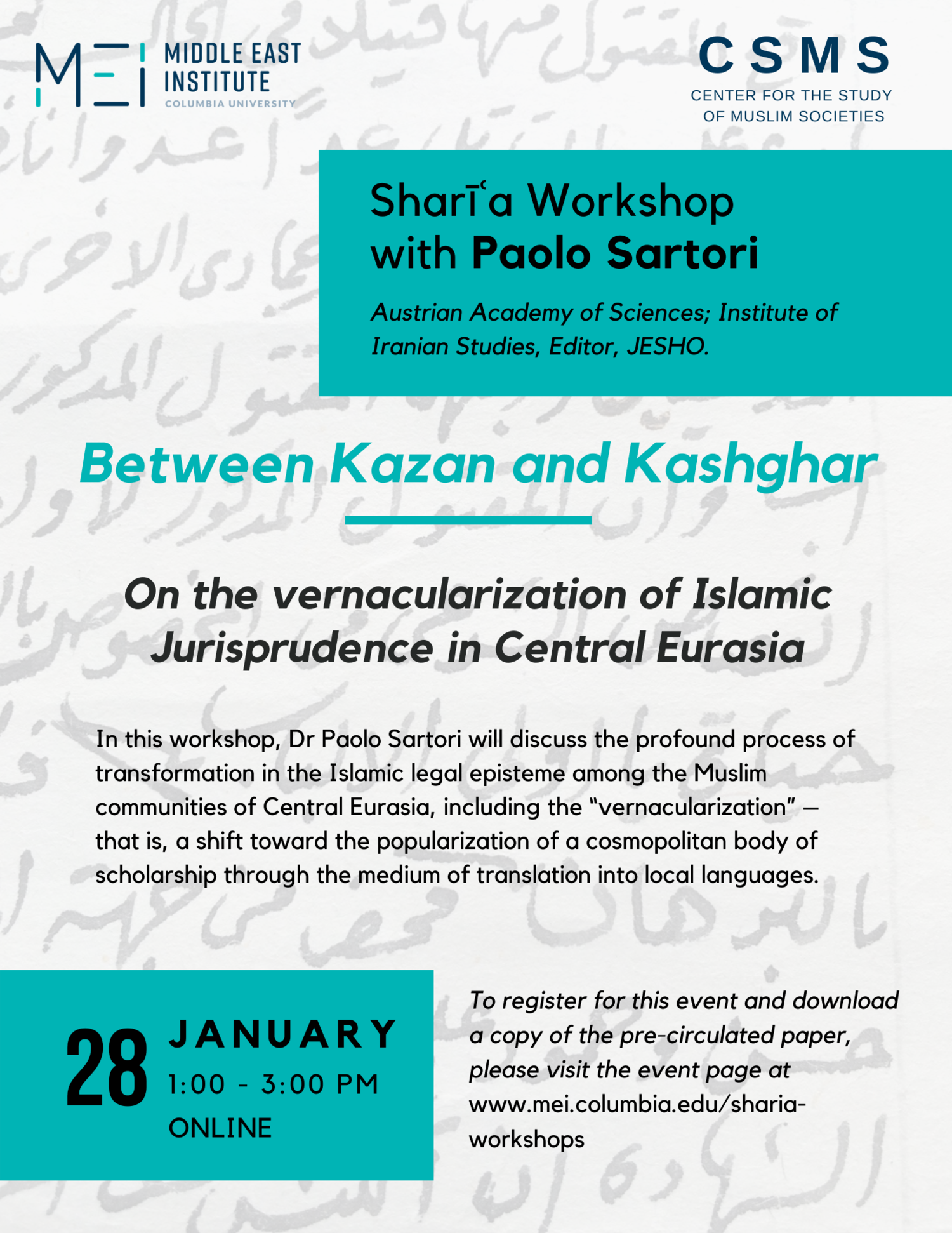
January 28: Shari'a Workshop: Between Kazan and Kashghar

Thursday, January 28, 2021, 1:00 PM - 3:00 PM EST

Register for the Zoom webinar here.

In this workshop, Dr Paolo Sartori will discuss his paper entitled, Between Kazan and Kashghar: On the Vernacularization of Islamic Jurisprudence in Central Eurasia. In this article he suggests that what today is known as “entexting” in the Western historiography of Islamic law did not just originate from colonialism. Emphasis on a self-contained number of jurisprudential texts was in fact one of the outcomes of a profound process of transformation in the Islamic legal episteme among the Muslim communities of Central Eurasia. One of the forces behind such a transformation can be identified in what Sheldon Pollock has termed “vernacularization” – that is, a shift toward the popularization of a cosmopolitan body of scholarship through the medium of translation into local languages. The act of translation itself reflected the effort to select, domesticate, and naturalize, specific juristic texts, the contents of which were perceived as important, though equally inaccessible. Translation led to distinction and preferment. It also brought about a process of “debasement”, i.e., a movement toward the decontextualization of Islamic jurisprudential writing traditions and their reworking into original works written in the vernacular Turkic, which blended the genre of creeds with jurisprudence.

Download article here.

Sharia+Workshop+1_28_21.png

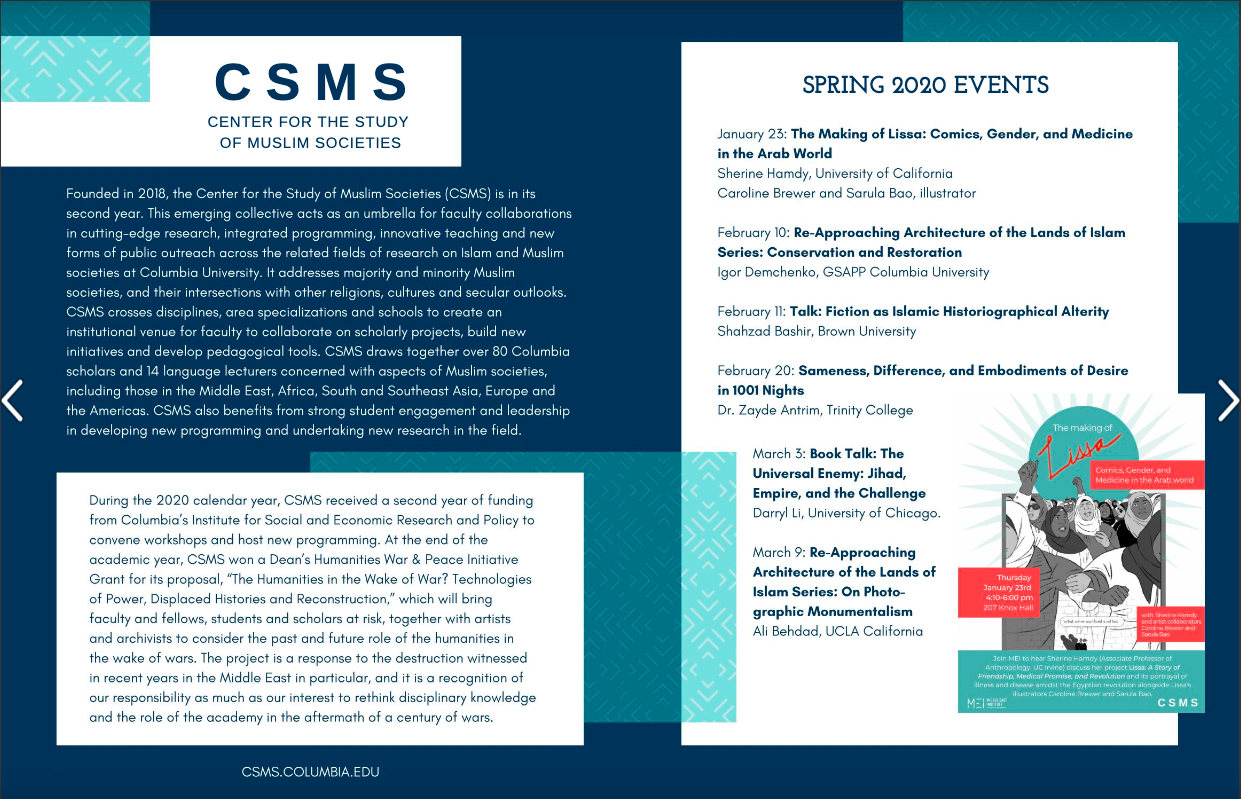
CSMS Year in Review

2020 will be remembered for the dual impacts of the Covid-19 rampage in New York City, with the loss of lives and economic turmoil, and also of the widespread protests and calls for racial justice associated with the Black Lives Matter movement.

Despite the challenges, CSMS is grateful for the support of the community in coming together for a variety of events and programming. This was most embodied by our virtual concert in May to celebrate Columbia University's 2020 graduating class, and to mark the official launch of the Center for the Study of Muslim Societies. This extraordinary concert brought together a diversity of Muslim musicians who shared their incredible talents from their living rooms across the country. In solidarity with movements in protest of racial inequalities, racism and bigotry, their shared voices transcended boundaries and demonstrated how we can all unite even in these challenging times.

We invite you to read our CSMS Year in Review to learn more about our work over 2020. Thank you all for your continued engagement and support for CSMS and we look forward to many new opportunities and events in the new year.