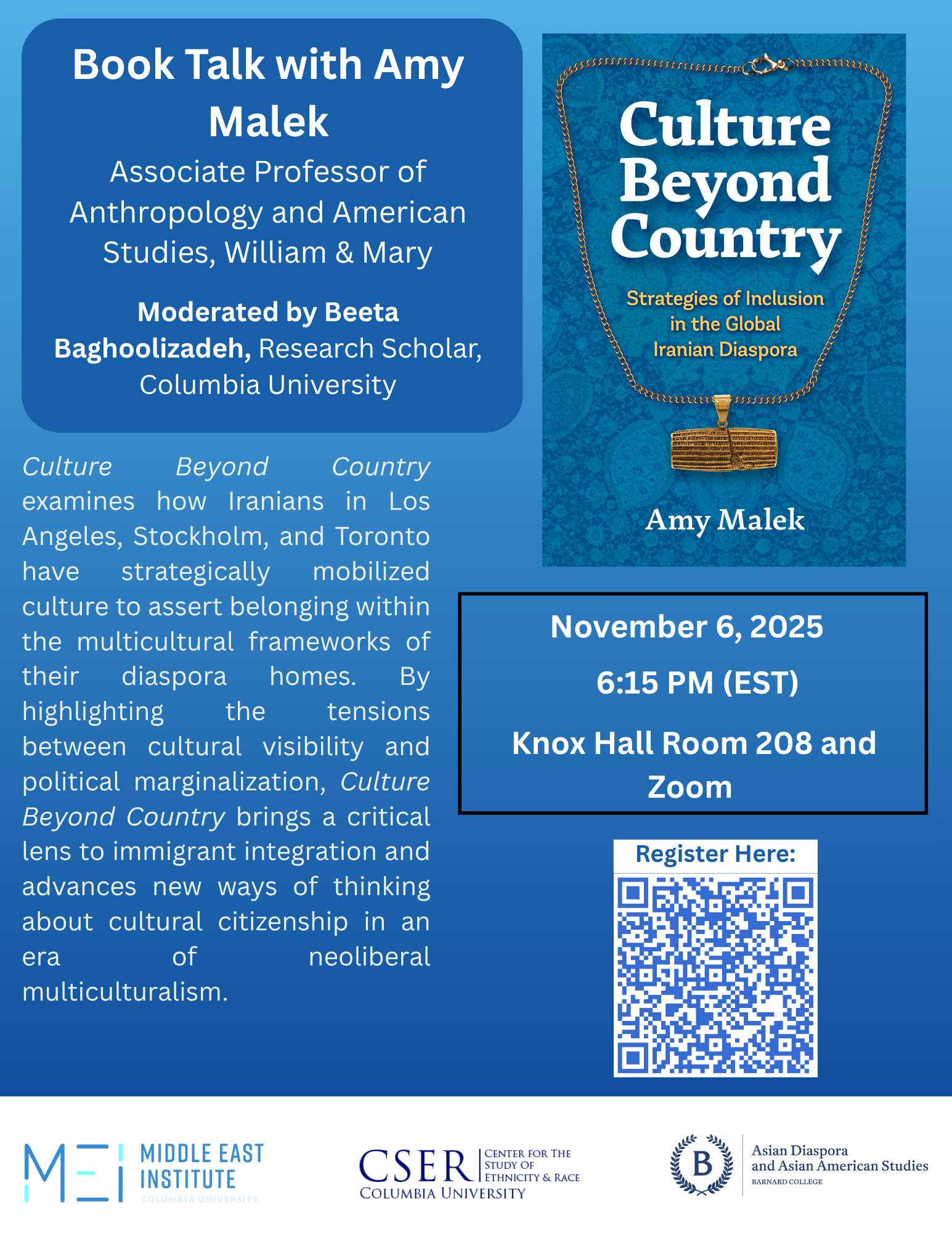
Culture Beyond Country: Strategies of Inclusion in the Global Iranian Diaspora

November 6, 2025 
6:15 PM
Knox Hall Room 208 and on Zoom

Amy Malek, a sociocultural anthropologist specializing in the intersections of migration, citizenship, memory, and culture in the Iranian diaspora, will discusses her new book, Culture Beyond Country: Strategies of Inclusion in the Global Iranian Diaspora. Her scholarship has been published in a wide variety of interdisciplinary journals, such as Memory Studies, the International Journal of Cultural Studies, and Iranian Studies. Her new book, forthcoming from New York University Press, is an ethnographic examination of the impacts of cultural policies on diasporic Iranian communities in Sweden, Canada, and the United States. 

Sponsors:

Center for the Study of Ethnicity and Race

Asian Diaspora and Asian American Studies, Barnard College
Register

Must the Imām be designated by his predecessor? The early development of the concept of waṣiyya in Shīʿī Islam

Monday, December 2 
5:00 PM - 7:00 PM
Knox Hall, Room 509

Join James Weaver, Professor at the University of Zurich in the Middle Eastern Studies Department, for a conversation on the historical and theological underpinnings of the doctrine of Waṣiyya (designation) and its role in early Shīʿī thought. To attend this event, please register below to receive the pre-circulated paper.

Register

Taqīyah and Tawriyah: Dissimulation and the Art of Ambiguity

Friday, November 22
4:10 PM - 6:00 PM
Knox Hall, Room 208

Join Devin J. Stewart, Professor of Arabic and Islamic Studies at Emory University’s MESAS Department, for a conversation on Taqīyah and Tawriyah: Dissimulation and the Art of Ambiguity. To attend this event, please register below to receive the pre-circulated paper.
 

Register

Can Pre-Islamic Architecture be Islamic Architecture? The Rock-Cut Tombs at Hegra

Tuesday, November 19 
6:10 PM - 8:00 PM
612 Schermerhorn


From an early date, Islamic writers connected the Qur’anic Thamud with Hegra, an abandoned Nabatean- Roman site in the Northern Hijaz now known, by reason of that association, as Mada’in Salih. The site itself thus forms a kind of bridge across the historical rupture separating Islam from Jahiliyya. What exactly happens to such a site when it becomes “Islamic?” This talk explores how the idea of constructing Islam works as a monumentalizing lens that changes the way we look at pre-Islamic architecture by blurring some features even as it makes others stand out in sharp relief. At Hegra, it will be argued, the effect of this reinterpretation produces rupture where it might have been possible to see continuity in a way that turns Nabatean ruins into an infrastructure for producing Islam.