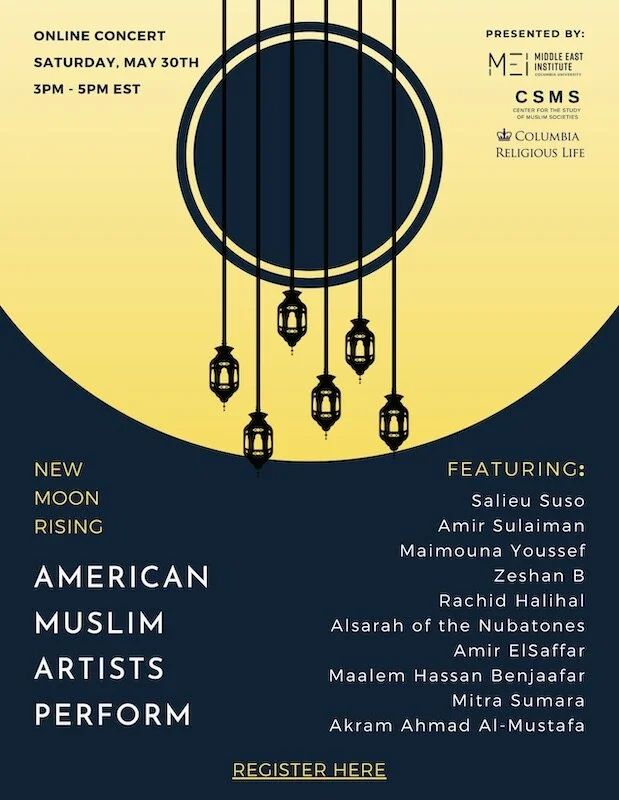
Artist Bios
Salieu Suso
Salieu Suso was born into a family of farmers and traditional musicians/historians from Gambia, West Africa, that extends back nearly 1000 years. He was trained to play the 21 stringed Kora (West African Harp) at the age of 8, by his father, renowned Kora player of that region, Alhaji Musa Makang Suso. He is recognized to be a descendant of JaliMady Wulayn Suso, the originator of the Kora instrument. Suso graduated from high school in The Gambia, speaks English fluently, Mandigo, Fula, Wolof, Sarahuli, and some German. Before settling in the United States in 1989, Suso performed extensively throughout Africa and Europe. Salieu Suso is also the leader of the “Jaliya Kafo”–extended family Music Ensemble, and is a leader in the nation’s rapidly growing African music scene. Suso actively freelances with other groups in the U.S.
Amir Sulaiman
Amir Sulaiman is a poet, recording artist, Harvard Fellow, screenwriter and producer born in Rochester, New York. His poems cross subjects of love, tragedy as well as what it means to reconcile humanity with the unprecedented trials of modernity. He is a writer and producer on RAMY on Hulu. As a poet, he has performed his works across the US as well as many other countries including England, Belgium, Senegal, Kingdom of Saudi Arabia, Sweden, Australia, Iran and the Netherlands, and continues to tour world-wide. His recently published book of poetry, Love, Gnosis & Other Suicide Attempts met with critical acclaim, in addition to his latest album "The Opening," the third in a unique trilogy project, following "The Meccan Openings" (2011) and "The Medinan Openings" (2012). Amir was first introduced to a National audience in 2005 when he was featured for two seasons on Russell Simmons' groundbreaking series Def Poetry Jam on HBO.
Maimouna Youssef (Mumu Fresh)
Maimouna Youssef (also known as Mumu Fresh) is a GRAMMY-Nominated singer, MC, songwriter, activist and acclaimed Hip Hop artist who’s been called a “quadruple threat” by The Roots’ Black Thought and “groundbreaking” by Oscar-winning artist, Common.In 2018, Maimouna Youssef became the songwriter and voice of Ford Motor Company’s “Roll On” campaign celebrating Women of Color, and was awarded the prestigious post of “Musical Ambassador for The United States,” travelling to Central America to support the rights of young women. Maimouna’s Afro-Native roots and rich activist history have spawned collaborations with philanthropic leaders including W.K. Kellogg Foundation, IMAN, Congressional Black Caucus, and Global Citizens Festival. She’s shared her story of Afro-Native artistic and philanthropic excellence while making appearances on MSNBC, FOX 45, NPR, CNN, Sway In The Morning and global network, Al Jazeera. In 2019, Mumu performed at the BET Black Girls Rock! Awards and received a standing ovation for her soul-stirring performance of her song “Say My Name” honouring Sandra Bland and the Mothers of the Movement (M.O.M), which is a group of women whose African American Children have been killed by police brutality or gun violence. Later that year, she delivered a soulfully nostalgic tribute to hip hop supergroup and cultural pioneers Arrested Development with gospel artists Mali Music, Travis Greene and rapper Dee-1 that aired on Black Music Honors. As a songwriter, she’s co-written songs with and for artists like Grammy and Oscar winner Common, Glenn Lewis, The Roots, Disney’s Vanessa Hudgins, hip Hop Duo, Dead Prez, Indigenous rapper and dancer Supaman, and Oddisee among others.As a performer, Maimouna has shared the stage with countless icons and legends in the making including: The Roots, Dave Chappelle, Sting, Bobby McFerrin, Lala Hathaway, Erykah Badu, Rapsody, Burna Boy, BJ The Chicago Kid, Common, Mali Music, Lauryn Hill, Ed Sheeran, Billy Ray Cyrus, D’Angelo, Femi Kuti, Aloe Blacc, Zap Mama, Bruno Mars, and Nas.In 2018, Maimouna received international acclaim for featured performances on NPR’s Tiny Desk Concert Series as a solo artist as well as alongside Common, Robert Glasper, Karriem Riggins, Black Thought and DJ Dummy. NPR calls her “an abundantly gifted singer and emcee” with “multi-octave range and ferocious rap delivery.”Her stage show has been called a “unique”, “spiritual” and “life changing” experience, captivating audiences at world-famous venues around the globe such as Lincoln Center, Harlem Stage, NYC Summer Stage, Carnegie Hall, The Kennedy Center, Montreux Jazz Festival (Switzerland), Sundance Film Festival, Jazz Café (London), Red Rocks Amphitheater (Denver), Central Park SummerStage (New York), Rueben Dario National Theater (Nicaragua), The Recording Academy’s “Grammy Festival At Sea,” and New Africa Shrine (Lagos, Nigeria), and opening Artist for Common’s national “Let Love” Tour.With three solo independent projects to her credit (“The Blooming” (2011) , “The Reintroduction of Mumu Fresh” mix tape (2014) and the “Vintage Babies” with DJ Dummy(2017) — and film credits including Queen Sugar, Being Mary Jane, Girls’ Trip and Dave Chappelle’s Block Party— Mumu Fresh is building a growing international online fan base of over 180k loyal fans and two new EPs on the way. Mumu Fresh has been busy collaborating with GRAMMY-Award winning producer DJ Jazzy Jeff’s PLAYList session creatives and most recently she released a viral single and video with award winning producer Salaam Remi entitled, “EmOGs”.Behind the scenes, Youssef serves as a Governor for the DC chapter of the Recording Academy’s Grammy Board as well as a mentor for several Grammy U affiliated young aspiring artists. She has received recognition from several local non-profit organizations such as One Common Unity, Bmore News, & Womb Work Productions as well as international awards from Mayor Luis Fernando Castellanos Cal of Tuxtla Gutierrez, Mexico for her outstanding service and commitment to the youth worldwide. Maimouna’s work continues to establish her as a true Global Citizen, a musical healer, teacher, powerhouse performer, and community pillar.
Zeshan B
Chicago native Zeshan B’s breakout album “Vetted” was released in April 2017 to commercial and critical acclaim with the album debuting at #8 on Billboard's Top 10 Albums (World Music) and peaking at #1 on iTunes’ World Music chart. Additionally, “Vetted” has received rave reviews from Rolling Stone, NPR, ABC, NBC, PBS, Salon, Democracy Now and the Times of India. Zeshan's hit single from the album “Cryin in the Streets”--his reinterpretation of George Perkins' 1970 classic civil rights anthem--has garnered praise from the New York Times, PRI, American Songwriter, and Chicago Tribune for its musical finesse as well as its relevance in America's current socio-political climate. In August of 2017, Zeshan made his US television debut with a stirring rendition of his hit single, “Crying in the Streets” on CBS’s Late Night w/ Stephen Colbert at the historic Ed Sullivan Theater. This was followed by a PBS NewsHour special (“Groovin’ for Change”).
Since then, he continues to be on tour with appearances at iconic venues and festivals such as the Lincoln Center, Bonnaroo, Electric Forest Fest, House of Blues (Boston), Kennedy Center, the Blue Note (NYC) and the Canadian National Exhibition. He has performed for two US Presidents--Jimmy Carter and Barack Obama--with the latter performance taking place at the White House’s historic inaugural Eid Celebration in 2016.
Most recently, In February of 2020, released his anthemic single, “Brown Power” with a music video featured by NowThisNews. The video included cameos from luminaries such as Reverend Jesse Jackson, Rep. Ilhan Omar, Dr. Cornel West, Hasan Minhaj, Nina Turner and many others. Zeshan has since released his critically acclaimed album, “Melismatic” in May of 2020 and appeared alongside his wife, Dr. Alexandra Roybal, on MSNBC Morning Joe to discuss the impact of COVID-19 on minorities and musicians.
Rachid Halihal
Rachid Halihal is a world class musician specializing in the music of Morocco, North Africa, and Andalusia.A classically trained vocalist and instrumentalist, he is a virtuoso on the Oud, the predecessor of the lute, and an accomplished violinist.
A native of Fez, Morocco, Rachid began his music studies at the age of fourteen at the Conservatory of Music in Fez. He has performed and given workshops internationally throughout Morocco, on the Ivory Coast, in the Arabian Gulf countries, in Finland, Canada, Panama, and throughout the United States. Rachid has played in Saudi Arabia with famous singers such as Mohammed Abdou and Majid Abdallah.
“Music brings people together,” says Rachid. “In my ensembles and my teaching all over the world, I have always welcomed people from different origins and different religions. Arabs and Americans, Muslims and Jews, Christians and atheists, Buddhists and secularists have all played in my ensembles.” He stressed that, “Music can be a [driving] force for understanding and world peace.”
Alsarah of the Nubatones
Alsarah is a singer, songwriter and reluctant ethnomusicologist. Born in Khartoum, capital of Sudan, she moved with her family to Yemen then settled in the United States after an abrupt departure. She feels most at home in Brooklyn, where she has been living since 2004. She asserts herself as an East African Retro-pop music artist and works on various projects which have been the subject of tours national and international. Accompanied by her group, Alsarah & The Nubatones, she released two albums Silt followed by Manara (Wonderwheel Recordings, in 2014 and 2016). She also released an album with French electronic music producer Débruit titled Aljawal (Soundways Recordings, 2013), and was invited on the first CD of the Nile Project, Aswan (selected among the top 5 albums most listened to by NPR in 2014 )
Amir ElSaffar
Composer, trumpeter, santur player, and vocalist Amir ElSaffar has been described as “uniquely poised to reconcile jazz and Arabic music,” (the Wire) and “one of the most promising figures in jazz today” (Chicago Tribune). An expert jazz trumpeter with a classical background, ElSaffar has created techniques to play microtones and ornaments idiomatic to Arabic music that are not typically heard on the trumpet. He is also one of the few musicians in his generation to master the centuries-old Iraqi maqam tradition, which he performs actively as a vocalist and santur (Iraqi hammered dulcimer) player. As a composer, ElSaffar has created a unique microtonal harmonic language that merges the Arabic maqam modal system with contemporary Western harmony. He has released seven critically acclaimed albums and tours internationally with several ensembles, including his six-piece Two Rivers Ensemble and 17-piece Rivers of Sound Orchestra, which combine elements of jazz, contemporary music, and Maqam. ElSaffar is a recipient of the Doris Duke Performing Artist Award and United States Artists Fellowship.
Maalem Hassan Benjaafar
Maalem Hassan Benjaafar is a Maalem or Master of Gnawa music. He is the son of the esteemed Maalem Abdullah Benjaafar of Fes, Morocco. He was raised and educated in Al Azhar Association for Culture and the Arts, an officially recognized zaouia (Gnawa school) his father founded and ran in the Medina of Fes jdid. As a youth he travelled throughout Morocco, living, studying and performing with Maalems in every region, including Maalem Sam of Casablanca, Maalem Ahmed Bakbou and Maalem Abdelatif of Marrakesh, Maalem Boujmaa of Fes, Maalem Abdelouahed Stitu and Maalem Mbarek Kasri of Tangier, and Maalem Hmida Boussou of Marrakesh and Casablanca. He learned the entire Gnawa music and dance repertoire, including regional variations and the Moroccan Jewish repertoire, as well as how to build and repair instruments.
While still a teenager, he was accorded the title of Maalem, which can only be bestowed by a consensus of other Maalems. He continued to travel and perform extensively as a featured singer, musician and dancer in hotels, private homes and other venues throughout Morocco, Spain and France. He also performed lilas or ceremonies in which participants are healed through music.
Maalem Hassan came to the United States in 1999 as the leader of a band of 10 Gnawa musicians. He relocated to New York City and has performed in clubs, festivals, museums, universities, schools and other venues. He has performed and recorded with musicians such as jazz great Randy Weston and Balkan Beat Box. He conducts lilas in various venues. He has trained musicians in Gnawa instruments and repertoire.
Maalem Hassan is the lead singer and Artistic Director of Innov Gnawa. As Maalem he teaches the other members of the band. They perform in clubs, festivals, museums, universities, schools and other venues in the New York area and throughout the USA, including Coachella, Lincoln Center and Red Rocks Amphitheater. In November, 2017 Maalem Hassan and Innov Gnawa were nominated for a Grammy in Dance/Electronic for Bonobo Featuring Innov Gnawa: Bambra Koyo Ganda, a song that Maalem Hassan adapted from traditional repertoire.
Mitra Sumara
Mitra Sumara is New York City’s Farsi Funk diva. Backed by a group of international musicians, she revives the vibrant Persian pop and funk music silenced by the Iranian Revolution. The popular music of Iran in the 60s and 70s combined disco, funk, and Latin beats, with Middle Eastern melodies and poetic lyrics.
Mitra Sumara interprets hits by Iran’s beloved singers such as Googoosh, Soli, Leila Forouhar, and remakes intoxicating Southern Iranian Bandari beat tunes. Mitra Sumara’s debut album, Tahdig was loved by the press and featured on WNYC’s New Sounds and KCRW’s Rhythm Planet.
Mitra Sumara is Yvette Massoudi, who was adopted and raised by American parents in Los Angeles. After twenty years of writing and recording her own music (avant-pop group Birdbrain, I Fly; and H*E*R, Songs About the Mysteries of Housework and Nature) and performing in numerous rock bands and new music ensembles, Yvette discovered the popular music of pre-Revolutionary Iran. She founded Mitra Sumara after studying Farsi and re-uniting with her birth father. This project is an outgrowth of Yvette’s journey to reclaim her personal identity, and a love letter to the beauty of Iranian culture and music.
“Mitra Sumara” is a combination of Farsi words to mean “The light of our friendship.” It is a bridge across worlds, cultures, and families.
Mitra Sumara has performed at the Smithsonian Freer Sackler Asian Art Gallery and the John F. Kennedy Center Millennium Stage in DC and in New York City at National Sawdust, Le Poisson Rouge, Barbés, Alwan for the Arts, Brooklyn Bowl, Barbes, Nublu, and DROM. She is part of a family of music groups that perform in the NYC floating arty Disco Tehran.
Akram Ahmad Al-Mustafa
Name: Akram Elmostafa son of Dean of Sudanese art Ahmed Almustafa born in Sudan currently lives in the USA.
Music type: Performs modern Arabic- Sudanese classic music
Skills: plays Lute “OUD” ,keyboard and Hand Drum.
Background: Sang and performed “Madeeh” praising prophet Muhammad “PBUH”.
Profession: IT engineer and Consultant.
Irfaan Bukhari
Irfaan Bukhari is a Kashmiri singer-songwriter based in Delhi, India. He writes songs mostly in Urdu and Kashmiri languages however he loves to pick age-old classic ballads from the Kashmiri folklore and recomposes them in a fresh and breezy, contemporary sound. His compositions are usually dressed in soft Ukulele/Guitalele sounds.
Irfaan hails from Kashmir’s Baramulla district. After finishing his schooling, he moved to Delhi for his higher studies. He was passionate about music since his childhood while in 2009 he formed a rock band called ‘Firaaq’ with some of his closest friends at his college in Delhi. In 2012, after it disbanded, Irfaan went on a very long hiatus and reappeared in 2019, this time with a completely different style of music. He appeared on Instagram and started posting Kashmiri folk songs recomposed in a light and modern feel.
His first track ‘Tamanna’ was very well received. Written by the legendary poet Mehjoor, ‘Tamanna’ is an old folk song of separation and longing, from the perspective of a woman waiting for her man to arrive and heal her broken heart. With a fresh approach, Irfaan was able to interest and engage people especially the youth of Kashmir for whom folk classics were too outdated to have them on their playlists.
Since then he’s been putting out more and more folk music and has also started doing Urdu originals to reach to a wider audience. His first Urdu original ‘Duur’ that succeeded ‘Tamanna’ was also received very warmly. ‘Duur’ is a song that talks of hope in the times of despair, picturized on a boy grazing his horse in the woods and finding his lost smile in the words of a musician whom he spots playing at some distance.
Irfaan is currently working on his debut EP which he intends to release next year. His music has influences from musicians across the world. Some of the artists that he’s influenced and inspired by include Gustavo Santaolalla, Vital Signs, Sami Yusuf, Mohsen Namjoo and Ankur Tewari.
Irfaan is a creative director and editor by profession while music continues to be his most loved side passion. Apart from this, he also co-owns a cafe in his hometown called ‘Cafe Pirates’, a place known for the live gigs. One of the major reasons behind his reappearance with a different musical style was the time he learnt and explored music while being a creative director and artist relations manager at MTV Indies, a TV channel that revolutionised the independent music scene in India. Interestingly, his profession comes very handy as he generally produces music, directs and edits his music videos himself.